The Opus Tessellatum technique became the foundation of all mosaic art, transforming simple stone fragments into monumental canvases that have survived for millennia. This method allowed the Romans to move beyond simple ornaments and create large-scale images that adorned the floors of villas, public baths, and temples throughout the empire. Today, we see the legacy of this style in every tile of a modern interior, yet the true depth of the technique lies in its strict geometry and engineering precision.
What is Opus Tessellatum and what are the principles of this technique?
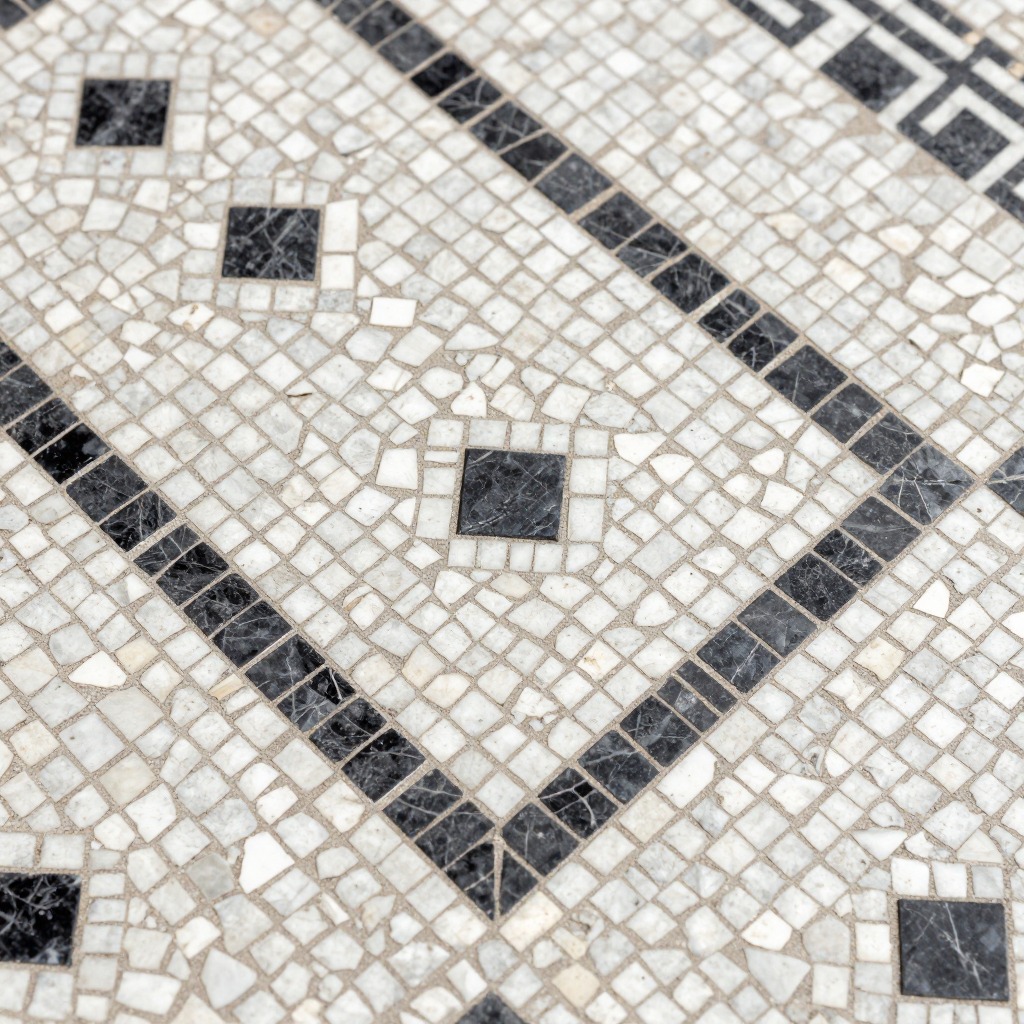
At its core, the Opus Tessellatum mosaic technique relies on the use of tesserae—small cubic fragments of natural stone, marble, smalt, or fired clay. Unlike earlier coastal mosaics made of pebbles, this method uses specially cut cubes, typically exceeding 4 mm in size. The main principle of the technique is the creation of a regular grid, where tesserae are laid in parallel rows to form backgrounds or fill large color planes. This allows for the coverage of vast areas at a high speed while maintaining structural durability.
The construction process for such mosaics in Ancient Rome was multi-layered, resembling modern foundation work. First, the statumen was laid—a layer of large stones for drainage, followed by the rudus (a mixture of rubble and lime), and then the nucleus (a thin layer of lime and crushed brick). Only after this did the master apply the final layer of mortar, into which the tesserae were pressed. This construction ensured that the floor would not crack under the weight of people or the passage of time. Masters used a palette of local materials: white marble from Carrara, black slate, or red limestone, giving the works a regional character.
History of development and evolution of Roman mosaic art
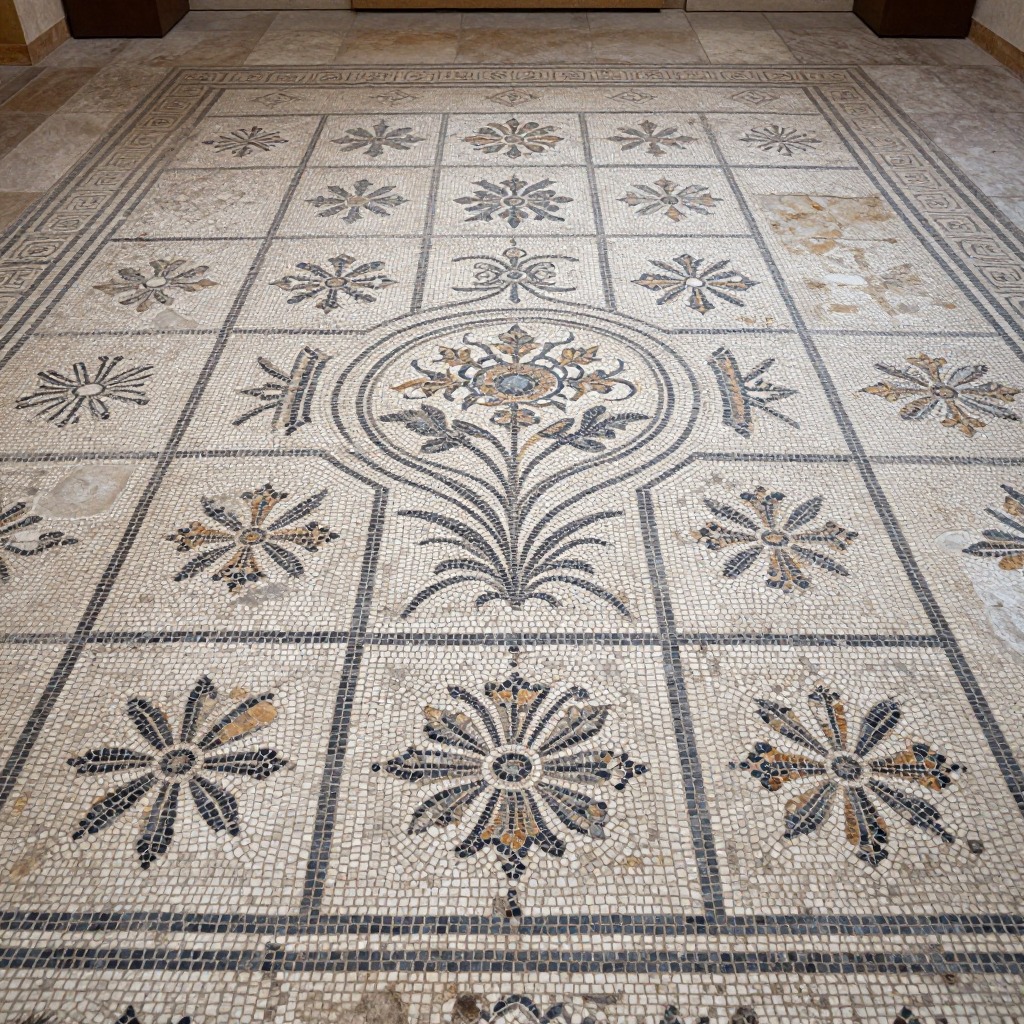
The development of this technique began by adopting Greek traditions, which the Romans then scaled to industrial proportions. In the 1st century BC and 1st century AD, mosaics ceased to be a luxury reserved for a few palaces and became a standard for urban space design. In Pompeii and Herculaneum, magnificent examples have survived where Opus Tessellatum was used to create geometric borders and expansive backgrounds that framed central narrative compositions. Over time, the technique evolved from simple black-and-white patterns to complex polychrome paintings.
By the 3rd and 4th centuries AD, the focus shifted from floors to walls and vaults, leading to the integration of gold smalt and glass. This paved the way for Byzantine art, where the rigidity of Roman rows was replaced by a more expressive delivery. A significant milestone was the emergence of professional mosaic guilds that created “catalogs” of standard patterns. This allowed villa owners to choose a specific type of ornament, which was then executed in the Tessellatum technique across the entire room, creating the effect of a stone carpet that neither faded nor wore out.
Opus Tessellatum vs. Opus Vermiculatum: what is the fundamental difference?
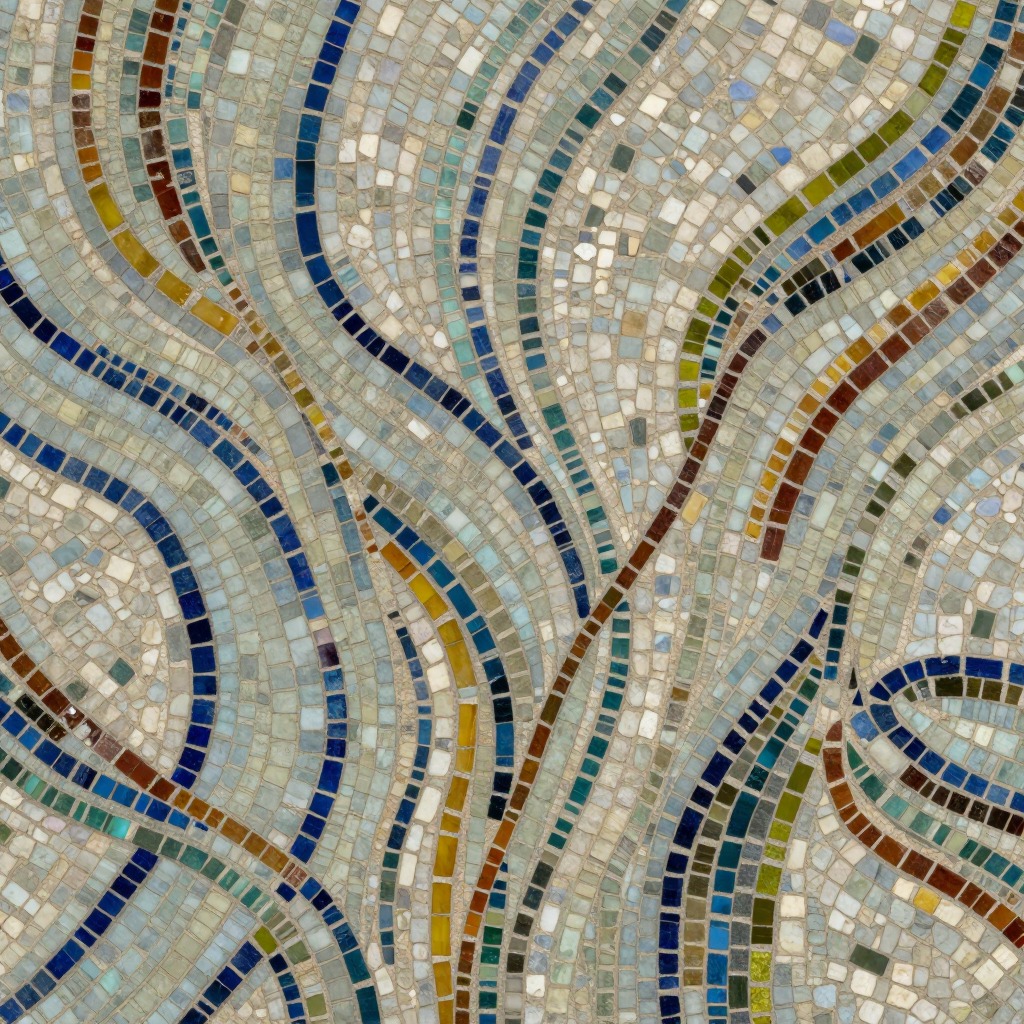
Novice researchers often confuse these two styles, but from a technical standpoint, they are opposites. If Opus Tessellatum is a “grid,” then Opus Vermiculatum (from the Latin vermiculus, meaning “little worm”) is a “line.” Vermiculatum uses microscopic tesserae ranging from 1 to 2 mm, which are laid not in straight rows, but in winding lines that follow the contours of the object. This allowed for almost painterly detail, creating smooth color transitions, shadows, and fine facial features that were impossible with the standard cube size of Tessellatum.
In practice, these two techniques worked in tandem. The Romans created so-called emblemata—small, highly detailed paintings in the Opus Vermiculatum technique, which were produced in workshops on special substrates. These “paintings” were then inserted into the center of a vast floor executed entirely in Opus Tessellatum. Consequently, Tessellatum served as the massive, stable background and frame, while Vermiculatum was responsible for the artistic center of the composition. This division of labor allowed for the combination of structural monumentality and jewelry-like precision.
Comparison with other techniques: from Opus Sectile to Trencadís
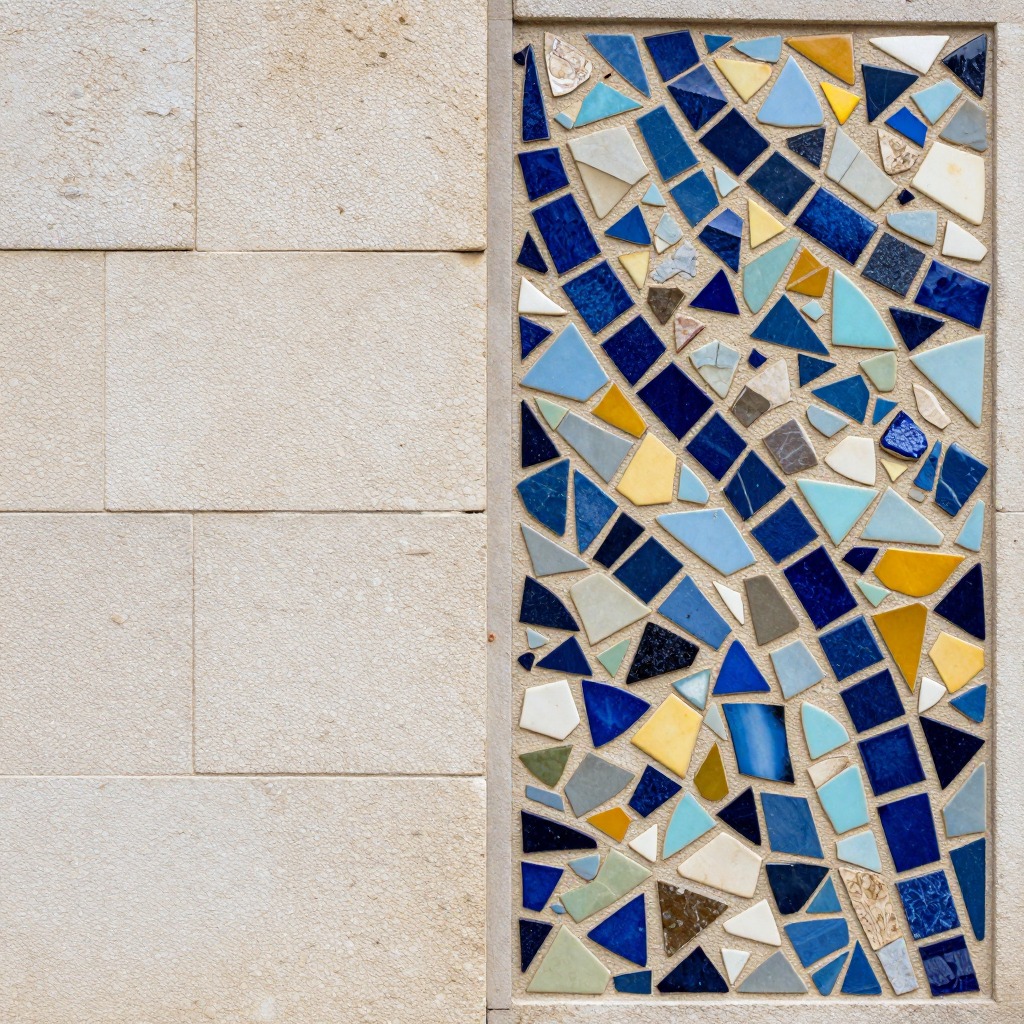
To fully understand the place of Opus Tessellatum in art, it is worth comparing it to Opus Sectile. While the former is based on small cubes, Opus Sectile involves the use of large plates of marble or semi-precious stones, cut to the shape of a specific element (such as a flower petal or a star). Sectile appeared much more expensive and prestigious, as it required rare materials and complex fitting of parts, whereas Tessellatum was a more democratic and versatile decorating tool.
Looking at the modern era, echoes of the Roman approach can be seen in the Trencadís technique popularized by Antoni Gaudí in Barcelona. However, Trencadís is a mosaic made of broken ceramics, where there is no strict adherence to the cubic form of the tessera. While the Roman master strove for row discipline and geometry, the modernists moved toward chaos and organics. Nevertheless, it was Opus Tessellatum that established the principle of image fragmentation, which became the basis for all modern tile art and even digital rasterization, where each pixel is essentially a modern tessera.
Modern revival and digital transformation in andamento.app
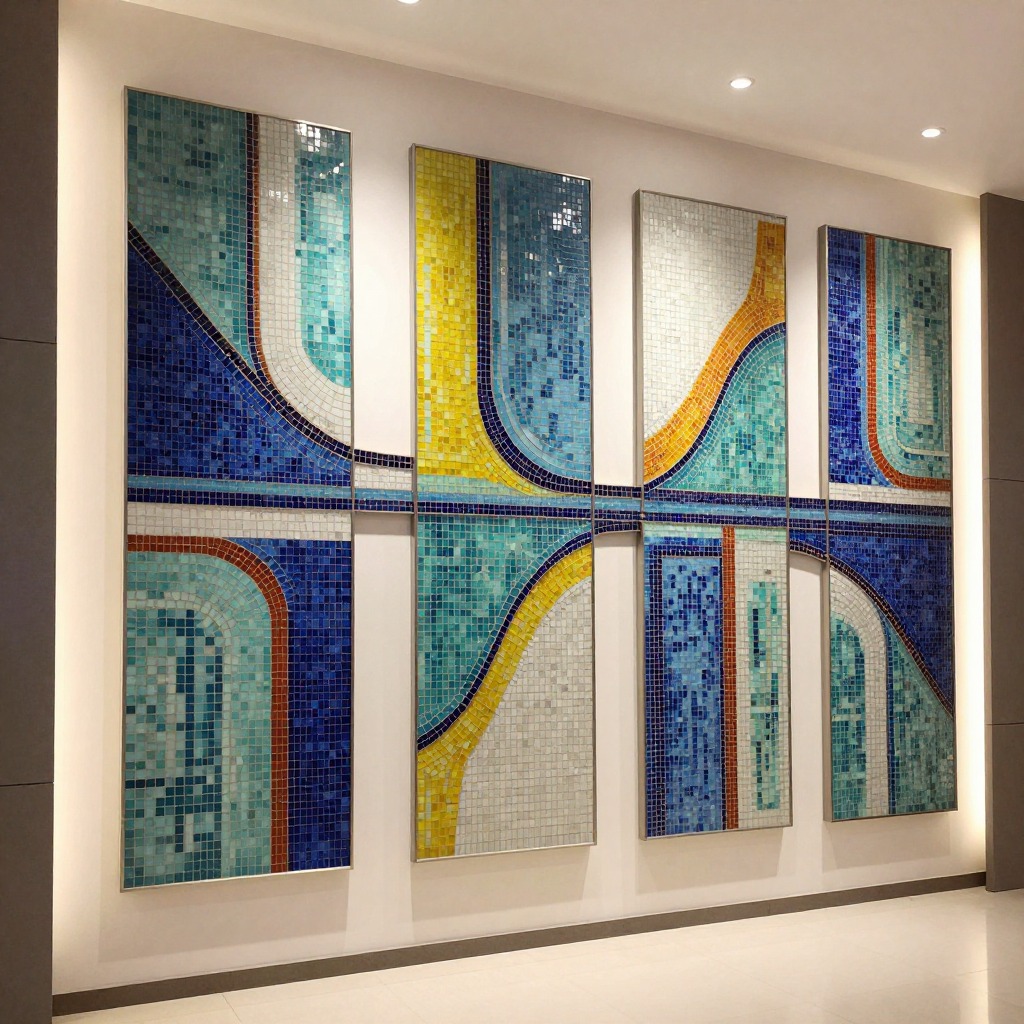
Today, interest in the classics is returning not only in architecture but also in digital art. Recreating the Opus Tessellatum mosaic technique digitally is a complex task, as the AI must simulate not just a “filter,” but the physical process of laying stone. The andamento.app service solves this through sophisticated algorithms that analyze Andamento (the direction of the rows). The system does not simply break the image into squares; it analyzes the shapes of objects and arranges the flow of tesserae as a Roman master would, creating natural curves and fills.
Related works in the gallery:
In andamento.app, modes have been implemented that allow the user to choose the level of detail, simulating the difference between Tessellatum and Vermiculatum. A user can upload a photo and transform it into a mosaic where the AI selects a palette of natural stones and constructs the grid according to classical canons. This allows one to see how a modern portrait or landscape would look on the floor of a Roman villa. The Classical AI and Matrix mosaic tools allow for precise adjustment of tessera size and grout width, making the result as close to a physical object as possible, creating a bridge between ancient craft and the technologies of the future.
If you want to feel like an ancient master and create your own work in the style of the Roman emperors, explore the possibilities of conceptual realization in andamento.app.